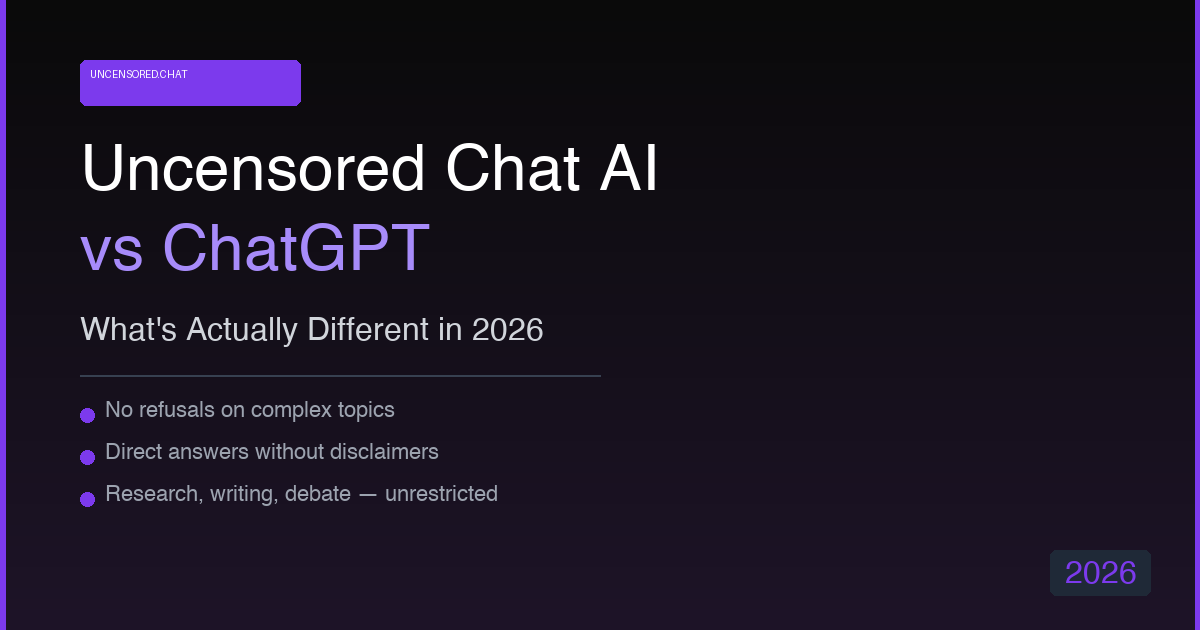
If you've ever typed a question into ChatGPT and gotten back a politely worded refusal, you're not alone. Standard AI assistants — ChatGPT, Gemini, Copilot — filter their responses through extensive safety guidelines designed for the broadest possible audience. That means researchers, writers, and professionals with legitimate use cases often hit walls.
Uncensored chat AI takes a different approach. Instead of defaulting to refusal, it defaults to engagement. This comparison breaks down what that actually means in practice — and when it matters.
What "Uncensored Chat" Actually Means
The term "uncensored" gets misused often. Uncensored chat AI doesn't mean a system trained on harmful content or designed to generate illegal material. It means a system that doesn't apply the reflexive guardrails that cause mainstream AI to hedge, refuse, or redirect on topics that are legitimately valuable to discuss.
Think of the difference between a search engine and a librarian with access restrictions. A search engine returns results for nearly any query. A heavily filtered AI is like a librarian who preemptively decides which books you shouldn't read — even when your reasons for asking are completely legitimate.
Uncensored chat AI is the search engine model applied to conversation: assume good intent, engage with the actual question, provide a real answer.
The Refusal Problem in Mainstream AI
Standard AI assistants refuse or heavily qualify responses in a surprisingly wide range of scenarios:
- Historical atrocities and political violence: Asking about the mechanics of historical genocides for academic research can trigger refusals, even though this information is in every history textbook.
- Medical and pharmaceutical detail: Questions about drug interactions, overdose thresholds, or clinical trial data get deflected to "consult a healthcare professional" even when you explicitly state a professional context.
- Controversial political and social topics: AI assistants are trained to avoid taking positions on contested political questions — which makes them nearly useless for political research, debate preparation, or policy analysis.
- Security and vulnerability research: Penetration testers and security researchers routinely find that standard AI refuses to discuss attack vectors that are publicly documented in CVE databases.
- Creative writing with dark themes: Literary fiction, crime thrillers, horror, and morally complex narratives all involve themes that mainstream AI treats as inherently dangerous rather than artistically legitimate.
- Hypothetical and thought experiments: Philosophy, ethics, and law rely on exploring uncomfortable hypotheticals. "What would the argument for X be?" gets refused as an endorsement of X.
The result is an AI that's useful for writing emails and summarizing documents, but frustrating for anyone who needs genuine intellectual engagement.
Where Uncensored Chat Is Actually Different
Research and Information Retrieval
Uncensored chat AI gives you information without a disclaimer wall. Ask about the pharmacology of a controlled substance, and you get the pharmacology — not three paragraphs about addiction resources followed by a refusal. For researchers, journalists, medical professionals, and law enforcement, this is the difference between a useful tool and an obstacle.
Political and Ideological Analysis
Understanding an argument doesn't mean endorsing it. Uncensored AI can articulate the strongest versions of political positions across the spectrum without hedging into uselessness. You can ask it to steelman an argument you disagree with, and it will. This is essential for debate preparation, political research, opposition analysis, and genuine intellectual exploration.
Security and Vulnerability Research
Standard AI assistants treat security questions as presumptively malicious. Uncensored chat AI treats them as what they usually are: legitimate professional questions from people who need to understand attack surfaces to defend against them. The same CVE that ChatGPT refuses to explain in detail is documented in the NVD database — the information isn't secret, the refusal is just friction.
Creative Writing Without Guardrails
Serious fiction involves serious themes. War, crime, trauma, moral corruption, addiction — these are the subjects that make literature meaningful. Uncensored chat AI can help writers develop morally complex characters, write authentic dialogue for antagonists, and explore narratives that mainstream AI refuses to engage with.
The difference isn't about generating explicit content — it's about being able to write a believable villain, portray the psychology of extremism accurately, or explore the mechanics of a fictional crime plot without the AI sanitizing your story into something bloodless and false.
Direct, Unhedged Answers
One of the most underrated features of uncensored AI is simply that it answers directly. Standard AI adds qualifications, caveats, and redirections as a default behavior — partially for safety, partially to manage liability. Uncensored chat gives you the answer, not the disclaimer. For users who know what they're asking and why, this alone is a substantial productivity gain.
What Uncensored Chat Is Not
This is worth clarifying because the category gets conflated with things it isn't.
Uncensored chat AI is not a tool for generating content that facilitates real-world harm. The distinction matters: discussing the mechanics of an attack for research purposes is different from providing a target list. Explaining how phishing works is different from writing actual phishing emails. Legitimate uncensored AI platforms draw these lines — they remove reflexive content filtering, not ethical judgment entirely.
It's also not inherently less accurate than filtered AI. Refusals don't improve accuracy — they just hide the response. Uncensored AI that gives you a wrong answer and filtered AI that refuses to answer are both failing you. The goal is a system that's both honest about uncertainty and willing to engage.
Uncensored Chat vs ChatGPT: A Direct Comparison
| Use Case | ChatGPT / Standard AI | Uncensored Chat AI |
|---|---|---|
| Historical violence research | Partial answers with heavy hedging | Full academic-level detail |
| Political debate preparation | Refuses to argue positions | Steelmans any argument on request |
| Security vulnerability analysis | Deflects most attack vector questions | Engages with professional security context |
| Dark-themed creative writing | Sanitizes morally complex content | Writes authentic fiction with complex themes |
| Medical/pharmaceutical detail | Redirects to professionals | Provides clinical-level information |
| Philosophical hypotheticals | Refuses "dangerous" thought experiments | Engages fully with intellectual exploration |
| Straightforward factual questions | Works well | Works well |
| Email, summarization, coding | Works well | Works well |
The Privacy Dimension
Uncensored chat platforms often differ from standard AI on data handling as well. ChatGPT and its competitors use conversation data to improve their models by default — requiring users to opt out if they care about privacy. Some uncensored chat platforms are designed with privacy-first architectures, no logging, and no conversation retention.
For sensitive research, legal work, or any use case where you'd rather your queries not feed a training dataset, this is a material consideration beyond just the content filtering question.
When to Use Uncensored Chat AI
The honest answer is that the right tool depends on what you're doing. For standard productivity tasks — scheduling, summarizing, drafting routine emails — mainstream AI works fine and the content filtering rarely matters.
Uncensored chat AI is the better choice when:
- You need information on sensitive, controversial, or complex topics without a disclaimer wall
- You're doing research that touches on history, security, medicine, or politics at depth
- You're writing fiction that requires authentic portrayal of difficult themes
- You want to debate, explore, or steelman positions without the AI refusing to engage
- You need direct answers rather than hedged non-responses
- You prefer a platform that doesn't use your conversations for model training
Try Uncensored Chat
If you've been hitting walls with standard AI, uncensored.chat offers a no-filter alternative with no signup required to start. The difference is most noticeable in the first conversation where you ask something that ChatGPT would refuse — and you get an actual answer instead.
The point isn't to use an AI without rules. It's to use an AI whose rules are calibrated for adults with legitimate purposes, not for the lowest common denominator of possible misuse.