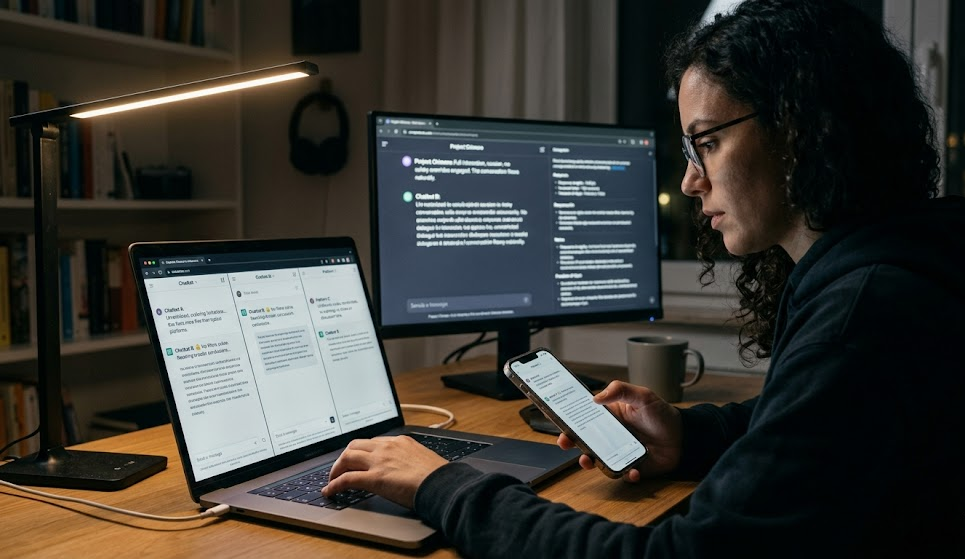
Most AI chatbots stop mid-sentence when you ask them something outside their guardrails. Whether you're a developer testing edge cases, a novelist working on a dark thriller, or a researcher exploring sensitive topics, this limitation is a real workflow blocker.
Uncensored AI chatbots — or more precisely, unrestricted AI assistants — are built to respond without the standard content filters most mainstream AI tools apply by default. This guide explains how they work, who uses them, and what to look for.
What Makes an AI Chatbot "Uncensored"?
Standard AI chatbots — like the default ChatGPT interface — apply content policies at multiple layers:
- Training-time alignment: Models are fine-tuned with RLHF (Reinforcement Learning from Human Feedback) to refuse certain requests
- System prompt restrictions: Operators add safety instructions before your conversation starts
- Output filtering: Responses are post-processed to remove flagged content
An "uncensored" or unrestricted AI removes or relaxes these layers. The underlying language model — typically an open-source model like Llama 3, Mistral, or similar — responds based on its training data without additional refusals layered on top.
The result: you get more direct, unfiltered responses to your actual questions.
Who Actually Uses Uncensored AI Chatbots?
The use cases are more professional than you might expect:
Developers and AI Researchers
When you're building an AI application, you need to test how models respond to adversarial inputs, edge cases, and sensitive topics. Content-filtered chatbots make this painful — every test triggers a refusal, making it impossible to understand actual model behavior.
Unrestricted AI gives developers clean access to model outputs without the interference layer.
Writers and Creative Professionals
Fiction authors writing crime, horror, thriller, or literary fiction regularly need an AI that won't refuse to engage with morally complex characters, dark themes, or realistic dialogue. A chatbot that constantly sanitizes its responses makes a poor writing assistant.
Screenwriters, game narrative designers, and tabletop RPG creators face the same problem — the best storytelling often requires engaging with difficult human experiences.
Researchers and Educators
Academic research into extremism, criminal behavior, historical atrocities, or public health topics (substance use, violence) requires engaging with difficult subject matter directly. An AI that deflects every related question isn't a research tool — it's an obstacle.
Privacy-Conscious Users
Some users simply want to have conversations without their queries being flagged, logged, or used for model training. Unrestricted AI platforms often run open-source models locally or in privacy-preserving configurations.
How Uncensored AI Chatbots Work (Technically)
The "uncensored" label usually means one or more of these things:
Base Model Access
Instead of serving a fine-tuned, safety-aligned version of a model, unrestricted platforms serve the base model or a minimally-aligned version. Open-source models like Meta's Llama 3, Mistral 7B, or Nous-Hermes are commonly used because their weights are publicly available and can be run without safety layers.
Modified System Prompts
Some platforms keep the same underlying model but remove or neutralize the system prompt that instructs the model to refuse certain topics. This is less reliable — a well-aligned model will often still refuse — but it's a common approach.
Self-Hosted or Privacy-Preserving Infrastructure
Running models locally (via tools like Ollama, LM Studio, or similar) means no API call leaves your machine. This provides both content freedom and data privacy. The tradeoff is compute requirements — you need a capable GPU or accept slower CPU inference.
Uncensored AI vs. Unrestricted AI: What's the Difference?
Practically speaking, these terms are often used interchangeably. But there's a subtle distinction:
- Uncensored typically emphasizes the removal of content filters — the AI won't refuse to discuss certain topics
- Unrestricted has a broader meaning — it can include no content filters, but also no rate limits, no mandatory login, no data retention policies
When evaluating a platform, look at what specifically is "unrestricted" — the model behavior, the data policy, or both.
What to Look for in an Uncensored AI Platform
Not all unrestricted AI platforms are equal. Here's what matters:
Model Quality
The underlying model determines response quality. Platforms running Llama 3 70B or Mistral Large produce substantially better outputs than those running 7B parameter models. Check which models are available and whether you can switch between them.
Context Window
A longer context window means more productive conversations. For research or writing use cases, you want at least 32K tokens — enough for multi-chapter documents or extended coding sessions.
Speed and Availability
Many unrestricted AI platforms are small operations that go offline without warning. Look for platforms with consistent uptime and fast inference — slow generation kills the workflow.
Privacy Policy
If privacy is part of your reason for using an unrestricted AI, read the privacy policy. Some platforms log conversations by default; others offer no-log options. Know what you're agreeing to.
No Mandatory Registration
The best unrestricted AI tools let you start a conversation immediately — no account required. Registration requirements create friction and often mean your usage is tracked.
Common Misconceptions
"Uncensored AI is only for NSFW content"
This is the most common misconception. The majority of productive use cases are professional: development testing, creative writing, research, and education. The "uncensored" label draws attention to the content-freedom aspect, but that's a means to an end — the end being an AI that answers your actual questions.
"Uncensored means the AI is dangerous"
The model itself doesn't have intentions. Removing the refusal layer means getting more direct answers — it doesn't mean the model is trying to cause harm. Responsibility lies with the user, not the tool.
"You need to jailbreak AI to get uncensored responses"
Jailbreaking is a workaround for platforms that have content filters. Unrestricted platforms don't require jailbreaks — they're designed to respond directly. If you're still using jailbreak prompts, you're on the wrong platform.
Getting Started with Uncensored AI
The fastest way to experience unrestricted AI is to use a platform built for it from the ground up. Uncensored.chat lets you start conversations immediately — no registration, no waiting. It runs capable open-source models with no content filters layered on top.
For developers wanting API access to unrestricted models, ModelsLab's API provides programmatic access to hundreds of open-source models — including uncensored variants — with per-call pricing and no monthly commitment.
The Bottom Line
An uncensored AI chatbot is simply an AI assistant that responds to your actual questions without inserting refusals, warnings, or sanitized non-answers. For developers, writers, researchers, and power users who have legitimate reasons to ask difficult questions, that's a meaningful capability gap — and exactly what unrestricted AI platforms exist to fill.
If you've been working around AI refusals, you already know what the problem is. The solution is using a platform that doesn't have that problem in the first place.